Brett Bohlinger—Austin Elizabeth
The Life ListBrett Bohlinger and Austin Elizabeth’s relationship begins in a crisis and becomes a mother-daughter bond through a promise, sustained care, and legal recognition. Austin is the child of Brett’s student and friend Sanquita Bell; after Sanquita asks Brett to take her baby, Brett accepts the responsibility of raising her. The relationship joins a private commitment to the public work of securing custody, then settles into the ordinary rhythms of motherhood.
A bond begun with a promise
Sanquita’s request comes when her health is failing after childbirth. She asks Brett to take the baby, and Brett, understanding that Sanquita fears she may not recover, promises to give the child a wonderful life and to tell her about her mother: how intelligent Sanquita was, how hard she worked, and how deeply she loved her. The promise does not treat Austin as a replacement for Sanquita or sever the child from her origins. Brett commits to carrying Sanquita’s story into the life she will build with Austin.
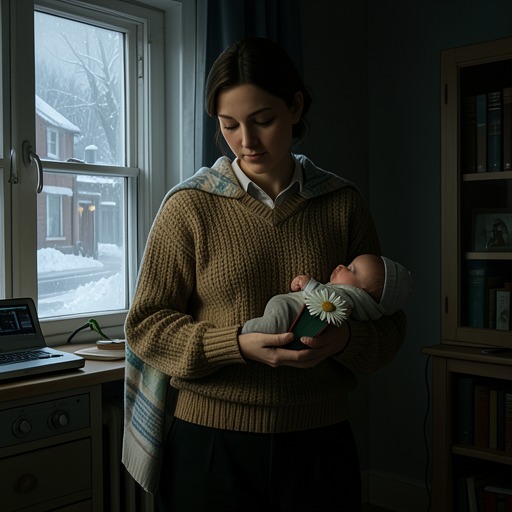
That commitment has an intimate, practical beginning. At the hospital, Nurse LaDonna places the newborn on Brett’s bare chest, settling Austin against her while a blanket covers them. Brett is still learning what caring for a baby entails; she wonders how long she is meant to hold Austin there and wishes she had a book or magazine. Yet when she speaks to the child, she names the loss plainly, telling Austin that her mother has died and that they loved Sanquita. She then tells Austin she will be her mother now, acknowledges that she is new to the role, and promises to do everything in her power to make the child’s life safe, sweet, happy, and good. The scene makes motherhood a commitment enacted before it is effortless or familiar.
From individual care to legal responsibility
Brett’s relationship with Sanquita had been built through teaching and friendship. During one visit, Sanquita tells Brett she is tired and asks for help earning her diploma, explaining that her baby should know her mother was smart. Brett agrees and takes a chemistry book from her bag. This exchange gives the later promise a history: Brett is not a stranger suddenly claiming a child, but someone who has listened to Sanquita’s hopes and helped her pursue them.
The commitment is tested when a social worker examines the circumstances of Sanquita’s death. Sitting beside Brad Midar in Kirsten Schertzing’s office, Brett recounts her relationship with Sanquita and the dying woman’s request. The medical chart says Sanquita lapsed into a coma after her C-section and records no one reporting her conscious during the thirteen hours before her death except Brett. The social worker asks whether Sanquita woke only long enough to ask Brett to keep the baby. Brett confirms that this is what happened. The scene exposes the gap between a promise Brett experienced as intimate and the evidence a formal process must assess.
At the custody hearing, that gap is answered by a document rather than by Brett’s account alone. Judge Garcia reads Sanquita’s notarized statement, dated March fifth, several weeks before her death. In it, Sanquita identifies Brett as her best friend and homebound teacher and requests sole custody of her unborn child for Brett if the child survives her. The judge grants Brett temporary custody until adoption procedures are finalized. Brett sobs with relief, but she does not stay to celebrate: she goes straight to the hospital to see Austin. The order changes Brett’s responsibility from a promise awaiting recognition into custody the court has authorized.
Motherhood in daily practice
After the hearing, Brett finds Herbert Moyer holding Austin in the neonatal unit. The small domestic gesture of visiting the baby together belongs to a relationship already moving beyond the courtroom: Brett calls Austin her baby, and her attention returns immediately to the child who has been hospitalized. The sequence sets the legal decision beside the daily presence that gives it meaning. Custody is not the end of the bond’s formation; it makes room for Brett to continue caring for Austin as her mother.
As spring gives way to summer, Brett’s routines change around her daughter. She trades heels and skirts for flip-flops and sundresses, and her three-mile runs become slow walks behind a baby buggy. Austin is happy and, apart from a few bouts of sneezing, remarkably healthy. Brett reads, sings, and talks to her; Austin listens, wide-eyed and focused. These details show a relationship developing through repetition and attention rather than through a single declaration. Brett also begins a journal for Austin, recording her growth and the similarities she sees between the child and Sanquita.
Kinship, memory, and inheritance
Brett’s journal for Austin gives the original promise a continuing form. She records details about Sanquita as well as Austin’s life, preserving the child’s connection to the mother who died while making a record for the daughter she is raising. Brett’s role therefore includes both present care and the work of remembrance. She intends to tell Austin about Sanquita, and the journal turns that intention into an ongoing practice.
The bond also changes how family is defined in Brett’s life. Earlier, questions about her own parentage had made biological identity a source of uncertainty; after finding her father, Brett still feels rejected when he cannot meet her immediately. Austin’s relationship with Brett takes shape by a different route: Sanquita’s written request, Brett’s acceptance, the court’s temporary custody order, and months of attentive care. The relationship’s significance lies in how these elements reinforce one another. A promise begins the bond, legal recognition protects it, and daily life makes it maternal. By the time Brett carries Austin through the familiar hospital hallway for the baby’s three-month birthday, she presents herself not as a temporary helper but as Austin’s mother, while keeping Sanquita present in the story of their family.